
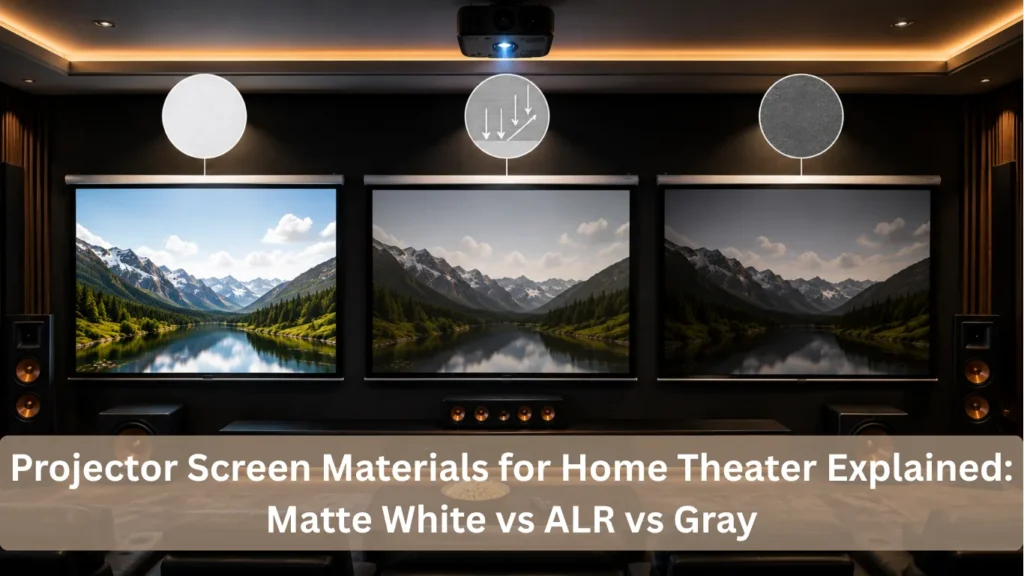
Choosing the right projector screen material for a home theater can make a noticeable difference in picture quality. The screen affects brightness, contrast, color appearance, and how well you can see the image when there is ambient light.
The three most common options are matte white, ALR, and gray projector screens. But which one is best?
The answer depends on your room lighting, projector brightness, viewing angle, and how you plan to use your home theater.
What Is the Best Projector Screen Material for a Home Theater?
There is no single projector screen material that is best for every room.
Matte white screens are generally a good choice for dark, controlled rooms. ALR screens are designed for spaces with unwanted ambient light, while gray screens can help improve perceived contrast in certain lighting conditions.
For the best results, choose the screen material based on your room rather than simply choosing the most expensive option.
What Is a Matte White Projector Screen?
A matte white projector screen uses a neutral white surface that spreads projected light across a broad viewing area. It is one of the most common choices for home theaters.
Benefits of Matte White Screens
- Natural and balanced colors
- Wide viewing angle
- Good choice for dark rooms
- Consistent image across the seating area
- Works with many home theater projectors
- Simple and versatile option
Matte white is particularly useful when you can control the room’s lighting. Closing curtains and switching off lights can help the projector produce a clearer and more immersive image.
Who Should Choose a Matte White Screen?
A matte white screen is a good option if you have a dedicated home theater or a room that can be made fairly dark.
If movie nights usually happen with the lights off, you may not need an expensive ambient-light-rejecting screen.
What Is an ALR Projector Screen?
ALR means Ambient Light Rejecting. An ALR projector screen is designed to reduce the effect of certain sources of unwanted light.
This makes ALR screens particularly useful in rooms where complete darkness is difficult to achieve.
Benefits of ALR Screens
- Helps reduce the impact of ambient light
- Can improve perceived image contrast
- Useful for living rooms and multipurpose spaces
- Makes projected content easier to see in brighter conditions
- Can be useful for daytime viewing
However, ALR does not mean that the screen eliminates all ambient light. Its effectiveness depends on the specific screen design and the direction of the projector and surrounding light.
Who Should Choose an ALR Screen?
Consider an ALR screen if your room has windows, lamps, or other light sources that cannot easily be controlled.
For example, if you want to use a projector in a living room during the day, an appropriate ALR screen may be more practical than a standard matte white screen.
What Is a Gray Projector Screen?
A gray projector screen has a darker surface designed to absorb some light and improve perceived contrast.
Gray screens can be useful when you want darker-looking blacks but still need enough brightness for comfortable viewing.
Benefits of Gray Screens
- Can improve perceived contrast
- May make dark scenes appear more defined
- Can work well in rooms with some ambient light
- Suitable for certain projector and room combinations
The main consideration is brightness. Because a gray surface absorbs more light than a typical white surface, your projector needs to provide enough brightness for the screen size and viewing conditions.
Matte White vs ALR vs Gray: What Is the Difference?
Feature | Matte White | ALR | Gray |
Best environment | Dark room | Room with ambient light | Low to moderate ambient light |
Color appearance | Natural | Depends on design | Can be slightly less bright |
Contrast | Balanced | Can improve perceived contrast | Often improves perceived contrast |
Viewing angle | Generally wide | Depends on material | Generally good |
Brightness | Good | Depends on design | Lower than comparable white |
Best use | Movies and home theaters | Living rooms and bright spaces | Contrast-focused setups |
The important point is that screen performance depends on the entire setup, not just the screen material.
Which Projector Screen Is Best for a Bright Room?
For a bright room, an appropriately designed ALR projector screen is usually worth considering.
However, screen material alone cannot solve every lighting problem. Direct sunlight, bright ceiling lights, and light-colored walls can still affect the image.
If possible, combine the screen with:
- Blackout curtains
- Controlled room lighting
- Strategic projector placement
- Darker wall treatments
- A projector with suitable brightness
Which Screen Is Best for a Dark Home Theater?
For a dark or dedicated home theater, matte white is often an excellent starting point.
It provides a neutral viewing surface and a wide viewing angle without requiring specialized ambient-light handling.
If your projector and room are already optimized for darkness, spending more on an ALR screen may not provide enough additional value to justify the cost.
How Does Projector Brightness Affect Screen Choice?
Projector brightness is an important part of choosing a screen.
A large screen requires more light to maintain a bright-looking image. A darker screen material can also reduce perceived brightness.
Before buying a screen, check:
- Your projector’s brightness specification
- The planned screen size
- How much ambient light enters the room
- Whether you mainly watch during the day or at night
This prevents the common mistake of buying a screen that is too demanding for the projector.
Does Viewing Angle Matter When Choosing a Screen?
Yes. Viewing angle describes how far viewers can sit to the side while still seeing a consistent image.
If your seating is spread across a wide area, a screen with a suitable viewing angle is important.
This is especially worth checking with ALR screens because some specialized materials can have more specific viewing requirements than standard matte white surfaces.
Common Projector Screen Buying Mistakes
Before purchasing a screen, avoid these common mistakes:
Choosing Only by Price
A more expensive screen is not automatically better for your room.
Ignoring Ambient Light
A standard white screen may struggle in a bright room, while an ALR screen may be unnecessary in a completely dark theater.
Forgetting Projector Brightness
Screen material and screen size should match the projector’s capabilities.
Ignoring Projector Placement
Some ALR screens work best with specific projector positions. Always check compatibility before installation.
Choosing Screen Size Without Considering Seating
A screen should provide an enjoyable viewing experience from your actual seating distance.
How Do You Choose the Right Projector Screen Material?
Use this simple rule:
Choose matte white for a controlled, dark room; consider ALR for rooms with unavoidable ambient light; and consider gray when improved perceived contrast is a priority and your projector has sufficient brightness.
Your projector, room, screen size, lighting, and seating should all work together.
Final Answer: Matte White, ALR, or Gray?
If you want a quick recommendation:
- Best for dark rooms: Matte white
- Best for rooms with ambient light: ALR
- Best when perceived contrast is a priority: Gray
- Best overall choice for a simple home theater: Matte white, when lighting can be controlled
The right projector screen material can make your home theater more enjoyable, but it should always be selected as part of the complete projection system.
Touch & Feel Electro System can help you plan a home theater setup based on your room, projector, lighting, and viewing requirements. A properly matched system can give you a more immersive experience without spending money on features your room does not actually need.
Frequently Asked Questions
What is the best material for a projector screen?
The best material depends on the room. Matte white is suitable for dark rooms, ALR works well when ambient light is difficult to control, and gray can help with perceived contrast.
Is ALR better than matte white?
Not necessarily. ALR is more useful in rooms with ambient light, while matte white can be an excellent choice for dark rooms because of its natural image and broad viewing angle.
Are gray projector screens good for home theaters?
Yes. Gray screens can be suitable for home theaters where improved perceived contrast is desired. However, projector brightness should be considered before choosing one.
Can I use a matte white screen in a bright room?
You can, but ambient light may reduce perceived contrast and image quality. If you cannot control the light, an appropriate ALR screen may be a better option.
Does projector screen material affect picture quality?
Yes. Screen material can influence perceived brightness, contrast, color appearance, and viewing consistency.
Should I choose the screen before the projector?
Ideally, the projector and screen should be selected together. Their brightness, screen size, material, and installation position all affect the final image.
What should I consider before buying a home theater projector screen?
Consider room lighting, projector brightness, screen size, viewing distance, seating position, projector placement, and whether you primarily watch movies, sports, gaming, or other content.
Conclusion
A projector screen is more than a surface for displaying an image. Matte white, ALR, and gray screen materials are designed for different viewing conditions.
If your room is dark, matte white is a reliable and versatile option. If ambient light is unavoidable, ALR can provide better performance in the right setup. If perceived contrast is your priority, a gray screen may be worth considering.
The smartest choice is the one that matches your projector, room lighting, seating arrangement, and viewing habits—not simply the screen with the highest price or most advanced-sounding name.
