
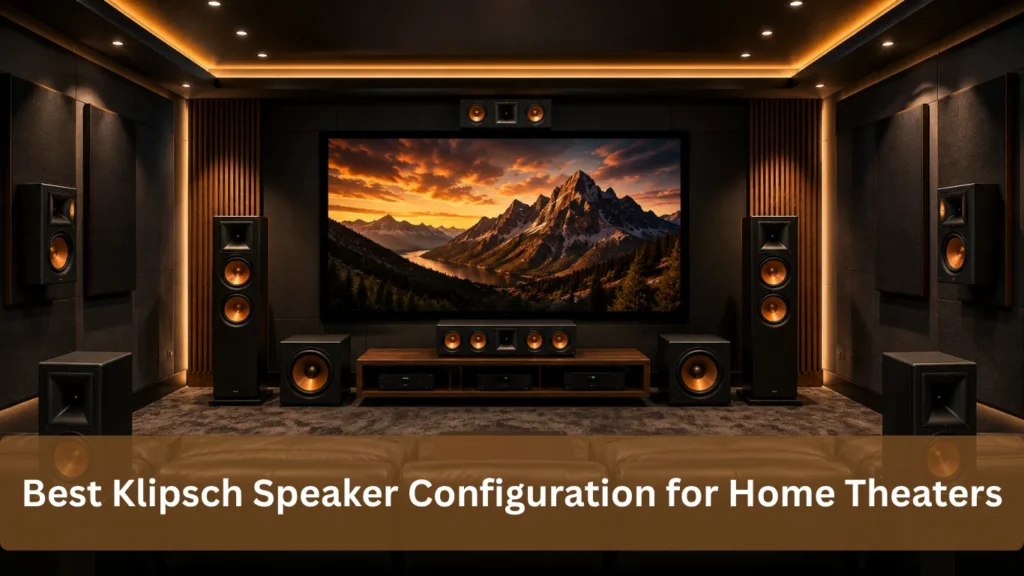
Choosing the right Klipsch speaker configuration depends mainly on your room size, seating arrangement, listening distance, and the type of experience you want. A 5.1 system is often enough for a small room, while medium and large home theaters can benefit from 5.1.4, 7.1, or 7.1.4 Dolby Atmos setups.
A well-planned system is not simply about adding more speakers. Speaker placement, subwoofer positioning, room acoustics, and AV receiver compatibility are equally important.
For homeowners planning a premium entertainment space, Touch & Feel Electro System can help design a home theater around the room and the viewer’s needs.
What Is the Best Klipsch Setup for a Small Home Theater?
For a small home theater or living room, a 5.1 or 5.1.2 Klipsch system is usually a practical choice.
A standard 5.1 system includes:
- Front left speaker
- Front right speaker
- Center speaker
- Left surround speaker
- Right surround speaker
- One subwoofer
If you want a more immersive experience, a 5.1.2 setup adds two height speakers for Dolby Atmos.
The main advantage of a smaller configuration is that it provides surround sound without overcrowding the room. Bookshelf or compact speakers can also be useful when floor space is limited.
Best for:
- Small living rooms
- Bedrooms converted into theaters
- Apartments
- Compact media rooms
- Two- to five-seat viewing areas
Recommended: Klipsch 5.1 or 5.1.2
What Is the Best Klipsch Setup for a Medium Home Theater?
A medium-sized room gives you more space to create a wider soundstage. For these rooms, 5.1.2, 5.1.4, or 7.1 can work well.
A 7.1 system adds two rear surround speakers to a traditional 5.1 setup. This can create better sound coverage when there is enough space behind the main seating position.
If immersive audio is your priority, consider 5.1.4. Four height speakers can create a stronger Dolby Atmos effect than a basic 5.1.2 system.
Best for:
- Medium living rooms
- Dedicated media rooms
- Family entertainment rooms
- Six- to eight-seat theaters
Recommended: Klipsch 5.1.4 or 7.1
What Is the Best Klipsch Setup for a Large Home Theater?
For a large or dedicated home cinema, a 7.1.4 Klipsch speaker configuration is a strong option.
A 7.1.4 system generally includes:
- 2 front speakers
- 1 center speaker
- 4 surround speakers
- 1 subwoofer
- 4 height speakers
This arrangement provides both horizontal surround sound and overhead effects.
A large room may also benefit from two subwoofers. Multiple subwoofers can help provide more consistent bass across different seating positions.
Best for:
- Dedicated home theaters
- Large entertainment rooms
- Multiple rows of seating
- Large-screen projector setups
- Movie enthusiasts seeking immersive sound
Recommended: Klipsch 7.1.4
Klipsch 5.1 vs 7.1 vs 7.1.4: Which Is Better?
There is no single configuration that is best for every room.
Configuration | Speakers | Ideal Room | Best For |
5.1 | 5 + subwoofer | Small | Simple surround sound |
5.1.2 | 5 + subwoofer + 2 height | Small/Medium | Entry-level Dolby Atmos |
5.1.4 | 5 + subwoofer + 4 height | Medium | Strong Atmos immersion |
7.1 | 7 + subwoofer | Medium/Large | Wider surround sound |
7.1.4 | 7 + subwoofer + 4 height | Large | Premium home theater |
The best configuration is the one that fits your room and seating layout. Adding speakers that cannot be positioned correctly may provide less benefit than having fewer speakers installed properly.
How Should Klipsch Speakers Be Positioned?
Speaker placement has a major effect on home theater performance.
The front left and right speakers should be positioned on either side of the screen and directed toward the main listening position. The center speaker should remain close to the screen because it plays an important role in dialogue reproduction.
Surround speakers should be placed beside or behind the seating area, depending on the system layout.
For Dolby Atmos, height speakers should be positioned according to the supported Atmos layout and the room’s ceiling conditions.
The main listening position should also be centered as much as possible between the left and right speakers.
Is Dolby Atmos Worth It With Klipsch Speakers?
Yes, Dolby Atmos can be a worthwhile upgrade if you want a more immersive home theater experience. Unlike traditional surround sound, which mainly places audio around the listener, Dolby Atmos adds height effects that can make compatible sounds feel as though they are coming from above.
If you are exploring Klipsch home theater speakers, choosing the right Atmos configuration can help you get better sound coverage without overcrowding the room.
For smaller rooms, a 5.1.2 setup is a practical starting point. Medium-sized rooms can benefit from 5.1.4, while larger dedicated home theaters may be better suited to 7.1.4.
Before choosing your setup, check that your AV receiver supports the required number of channels. Also consider your ceiling height, seating position, room layout, and speaker placement to get the best possible Dolby Atmos experience.
How Many Subwoofers Do You Need?
One subwoofer is enough for many small and medium home theaters.
However, a large room or theater with several seating positions may benefit from two subwoofers. Multiple subwoofers can help distribute low-frequency sound more evenly throughout the room.
The goal is not simply to produce louder bass. The goal is to create balanced and consistent bass across the listening area.
How Do You Choose the Right Klipsch Configuration?
Consider these five factors before purchasing your system:
1. Room Size
Measure the room before selecting the number and size of speakers.
2. Seating Position
The number and location of seats influence surround speaker placement.
3. Ceiling Height
If you are planning Dolby Atmos, check your ceiling height and the type of height speakers you intend to use.
4. AV Receiver
Your receiver must have enough channels and support the audio formats used by your chosen system.
5. Future Upgrades
If you plan to upgrade later, choose an AV receiver and speaker layout that can accommodate additional channels.
Final Answer: Which Klipsch Configuration Should You Choose?
For most users, the choice can be simplified:
- Small home theater: 5.1 or 5.1.2
- Medium home theater: 5.1.4 or 7.1
- Large home theater: 7.1.4
- Maximum immersion: 7.1.4 with carefully planned speaker placement and, where appropriate, multiple subwoofers
The best Klipsch speaker configuration is not necessarily the one with the most speakers. It is the setup that matches your room, seating, equipment, and listening goals.
If you are building a new home theater, Touch & Feel Electro System can help you plan the speaker layout, equipment, and installation according to your space.
Frequently Asked Questions
What is the best Klipsch speaker setup for a small room?
A 5.1 or 5.1.2 Klipsch setup is generally a good starting point for a small home theater. It provides surround sound without requiring too many speakers.
Is 5.1 or 7.1 better for a home theater?
A 7.1 system can provide wider surround coverage, but 5.1 may be better for a smaller room. Room size and speaker placement matter more than simply choosing the larger number.
Is 5.1.4 better than 7.1?
They serve different purposes. 5.1.4 adds four height channels for Dolby Atmos, while 7.1 adds rear surround channels. Choose 5.1.4 if immersive overhead audio is your priority.
Is 7.1.4 good for a large home theater?
Yes. 7.1.4 is a strong configuration for a large dedicated home theater because it combines wide surround coverage with four height channels for immersive audio.
Do Klipsch home theaters need a subwoofer?
A subwoofer is recommended for a home theater because it handles low-frequency effects that smaller main speakers may not reproduce with the same impact.
Can Klipsch speakers be used for Dolby Atmos?
Yes. Klipsch offers speaker solutions designed for Dolby Atmos home theater applications. The exact configuration depends on the room, receiver, speaker type, and installation method.
